Balancing Technique and Emotion While Playing the Sitar
- Home
- Balancing Technique and Emotion While Playing the Sitar

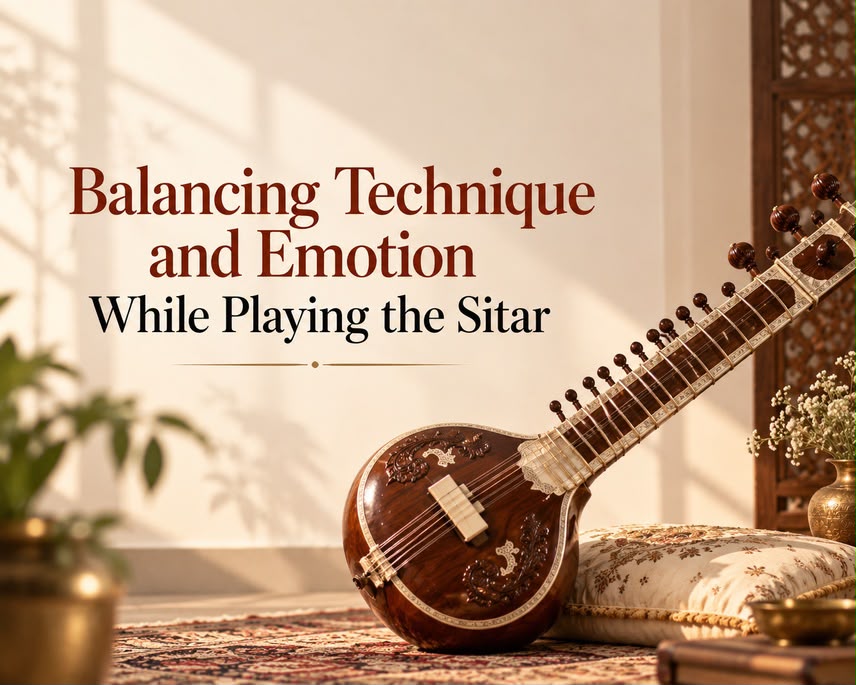
Sitar playing does not only include pressing the correct strings or learning the raga. Sitar music is an argument between discipline and feeling at its core. Form provides order and spirit provides life. When united with these two, the sitar instrument may convey moods, tales, and even noises with a significant impact.
Good sitar playing depends on strong technique. It entails proper posture, consistent meend (string bending), clear mizrab strokes and proper tuning. In their absence, the sound may not be smooth. The Indian classical music places much emphasis on the purity of notes (shuddh swar) and this can only be attained through constant and intensive practice.
Most of the beginners, aspiring to learn Indian classical music, tend to hurry to play complicated ragas. But, as all who have been training at their trade know, control is made by slow, gradual training at the fundamentals. Regardless of whether an individual is studying online in sitting classes or with a real instructor, technical discipline is what allows the hands to react instinctively to musical concepts.
Technique is the thing that influences the sound and emotion is the thing that influences the meaning. Ragas have a certain mood: calm, devotion, joy, and longing. Without emotion, a technically flawless work will be soulless. Emotion is involved in the details of selection: the duration of a note being held, the manner in which a phrase is initiated, or the use of silence as a medium between notes.
When the emotional intent is felt by the listener, they are likely to relate more. This is what has made the sitar music immortal. It gives room to individuality, but remains in a classical structure.
Striking a balance between technique and emotion is a time consuming exercise. Separating practice sessions is one of the practical solutions. Part of the time, do nothing but technique, scales, finger, and rhythm. Express yourself with another part; it is not necessary to worry about tempo, but simply listen to the mood of the raga.
Listening is also an important factor. Students can learn how emotion resides within structure by watching the masters at work using pauses, dynamics and other slight variations. Students who take sitar lessons in Delhi or study at home tend to observe that the progress is much faster when listening is as significant as playing.
With the assistance of a favorable learning environment, these two factors are balanced by default. Being a student who attends musical instrument classes in the area or a student studying under online sitar classes, consistency is more important than intensity. The benefits of brief and attentive practice are that with time, the emotional focus and technical consistency tend to improve.
Learning this balance is a slow process that is achieved through tradition, listening, and self-knowledge. Numerous students are clear in mind with profound teaching and consistent training with a mentor. Such an attitude towards learning the sitar can be traced in the teaching philosophy of Ratna Lahiri whose method of learning is characterized as one of patience, musical sensitivity and the admiration of the depth of the sitar tradition.