How Regular Sitar Practice Improves Musical Expression and Confidence
- Home
- How Regular Sitar Practice Improves Musical Expression and Confidence

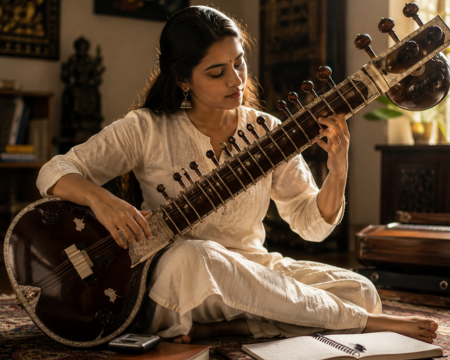
Music is not only about learning the notes but also learning the emotions, discipline and expressing yourself. In the case of Indian classical music, practice becomes crucial especially when being trained in the use of the sitar instrument. The regular practice of the sitar assists the learners to be sensitive to music and gain confidence that transcends beyond performance.
With the constant practice, students can be able to relate well to the sitar music. The sitar is said to have an expressive sound, which is largely determined by the pressure put by the fingers, timing, and control of meend (glides). Training every day makes the hands and ears collaborate, and the musician is able to express emotions more naturally. With time, the students start to notice the slightest changes both in sound and mood and become more expressive and polished in playing.
There is also the significant advantage of better rhythm and timing which comes through frequent practice. Indian traditional music is also very strict about tala (rhythmic cycles) and the absence of even a beat can influence the whole movement. Regular training trains the mind to be both focused and disciplined. Such a structure is typical in the classes of musical instruments, in which consistency develops precision and musical knowledge.
Music education research claims that students practicing at least 30-45 minutes on a daily basis improve in timing and tonal clarity faster as compared to those who practice with irregularity.
The confidence develops automatically when the students are ready. Even the everyday practice of the sitar makes one less hesitant, less afraid of one's errors. The repetition of compositions and ragas makes the learners more comfortable with the instrument and their skills. This trust is not only observed in the performance but also in the practice sessions, dialogues with teachers and group learning environments.
Most of the learners who study Indian classical music report an evident increase in the self belief as they advance through organized practice regimes.
Having online classes in sitar has made practice more necessary. Students who are disciplined are more likely to advance more quickly without the need to be supervised physically. Regularity leads to continuity, thus enabling learners to remember lessons and use techniques appropriately between classes.
Music is an effective emotional release. Practising the sitar regularly helps an individual to direct stress, learn patience and be mindful. With time, students discover that the expression of music becomes more personal depending on their level of emotional maturity and their knowledge of the art.
The practice of sitar on a regular basis forms musical ability and self-confidence. It enhances skill, elevates emotionality and contributes to discipline to facilitate growth in the long term. Independent learning or guided learning, the bottom line of the matter is consistency to make a significant change.
Ratna Lahiri helps in the preservation and transmission of the richness of Indian classical sitar by means of studying and engaging in rigorous training.