How Sitar Training Enhances Focus, Patience, and Creativity
- Home
- How Sitar Training Enhances Focus, Patience, and Creativity

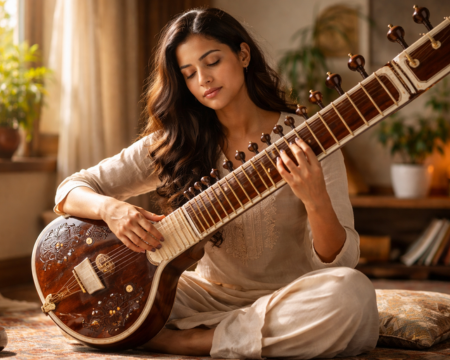
Studying a musical instrument can be regarded as a pastime activity; nonetheless, none of the effects is as significant as entertainment. The sitar instrument is regarded as a classic instrument in the Indian classics. It is particularly effective in the mental and creative development due to its organized educational experience and an extended manifestation of emotions. Formal or through online sitar courses, sitar training has a natural and permanent way of building focus, patience and creativity.
Learning Sitar requires a precision in learning. All the steps need concentration, e.g., changing the strings to the right pitch, keeping the right posture, and the right hand placement. When one is sitting and playing sitar music, the mind cannot roam. Every note, pattern of rhythms and change should be conscious.
Research on the use of music education indicates that regular practice of an instrument enhances attention span and memory. The Indian classical music especially trains the brain to remain available long time. Learners can easily develop the capacity to concentrate deeply without the need to be pressured to do so hence they practice ragas slowly and repeatedly.
The development of learning the sitar is slow. The sitar is not a fast-producing instrument like others are. Making a clean sound is in itself time consuming. This gradual learning process is a very natural way of learning patience.
Students who study based on formal classes with musical instruments are on their way to knowing that progress is not fast but by sustained effort. Emotional resilience is achieved through the discipline of performing basic exercises every day, making small errors and correcting them. As time goes by, the learners are patient even in life.
The Indian classical music is distinctive as it is based on the rules and freedom of imagination. Although ragas are governed by specific patterns, they are expected to be experimented with by musicians in terms of emotions and expression.
When students are learning Indian classical music, they start improvising. The process focuses on creative thinking. The mind is taught to stay within bounds and be able to say something personal and original. The training on the sitar improves the quality of imagination, emotional sensitivity and low-level creative thinking.
The effect of regular practicing of the sitar is calming to the mind. The stress is reduced by the vibration of the strings, slow tempos and meditation quality of ragas. The positive effects of mindfulness exercises are similar to those of practice in that many learners state that they feel mentally relaxed.
These benefits are enjoyed even by students learning the sitar in the online setups in Delhi, which demonstrates that the physical location does not limit the mental influence of music.
Learning how to play the Sitar is not a simple matter of learning notes but a self-development process. It determines the way the mind listens, waits and creates. This is the way of learning that is observed by Ratna Lahiri whose aim in teaching sitar is to encourage discipline, consciousness, and imagination with music and not fast successes in performances.