From Riyaaz to Performance: How Structured Sitar Training Shapes Artists
- Home
- From Riyaaz to Performance: How Structured Sitar Training Shapes Artists

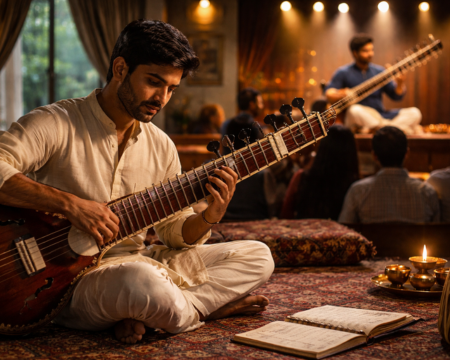
It is not only learning how to play the notes on the sitar: learning how to play it properly requires us to have some form of discipline, to be patient, and to know more about the language of sound. It is taught and practiced in Indian classical traditions that stage performance occurs after daily riyaaz leading to confidence. This traveller makes the musician and the music.
The instrument of the sitar is rather complicated and has a number of strings, complex tuning, and fine skills. Newcomers usually begin with posture, the position of hands and simple meend (glides). These initial lessons might be slow but they help develop the physical memory required in long term development. It is based upon this that advanced playing becomes challenging and unreliable.
Riyaz helps in strengthening the finger control, enhancing the hearing skills and rhythm awareness. In the long run, students start becoming aware of ragas, their mood, and to learn how timing alters how they affect them.
The unstructured practice may be discouraging and inconsistent. The systematic process divides learning into definite steps - basic training, raga building, taan and rhythmic circles. The stages prepare the student for the next stage.
Research in music education demonstrates that the students who adhere to guided practice schedules include musical concepts in a longer musical performance and demonstrate improved accuracy in the performance. Strategic learning is also less straining physically, such as in stringed instruments where the techniques are acquired incorrectly.
Online sitar lessons have increased the accessibility of organized training to many learners today. Online recorded lessons, practice routines, and feedback sessions ensure the stability of the students even in distance learning.
It is not only a matter of technical skill in performance. It involves trust, attention and being able to forgive oneself. Formal training involves mock performances, slow improvisation, and rhythm control which make the students remain calm on stage.
Later in learning students learn to pace an alap, generate energy during jod and use sound to express emotion. This is a progressive exposure that puts them in line with open concerts, recordings or even joint performances.
The students should also learn the cultural background of Indian classical music to gain true learning. Ragas are related to seasons, moods and the time of day. Listening sessions and theory training are part of the training, which enables the students to respect tradition but to have their own voice in music.
Classical education has a long history of cities such as Delhi and classes in Sitar in Delhi still carry the same tradition, albeit with a modern approach of teaching.
Discipline, direction, and time are what determine the process of Riyaaz to performance. Organized sitar lessons enable students to develop progressively, shun self-vices and perform music with a lot of confidence and clarity. Such a critical attitude towards learning is manifested in the philosophy of teaching of Ratna Lahiri, whose work is oriented towards the development of understanding, stasis, and respect towards classical music traditions.